

The first major Honey Production Assessment Report was officially released and handed over to communities in the Rupununi and key stakeholders on September 16, 2026 . This report is a key output of the collaboration between WWF-Guianas and the Rupununi Lifestock Producers Association (RLPA) under the EU-funded Sustainable Forest Livelihoods (SFL) Programme.
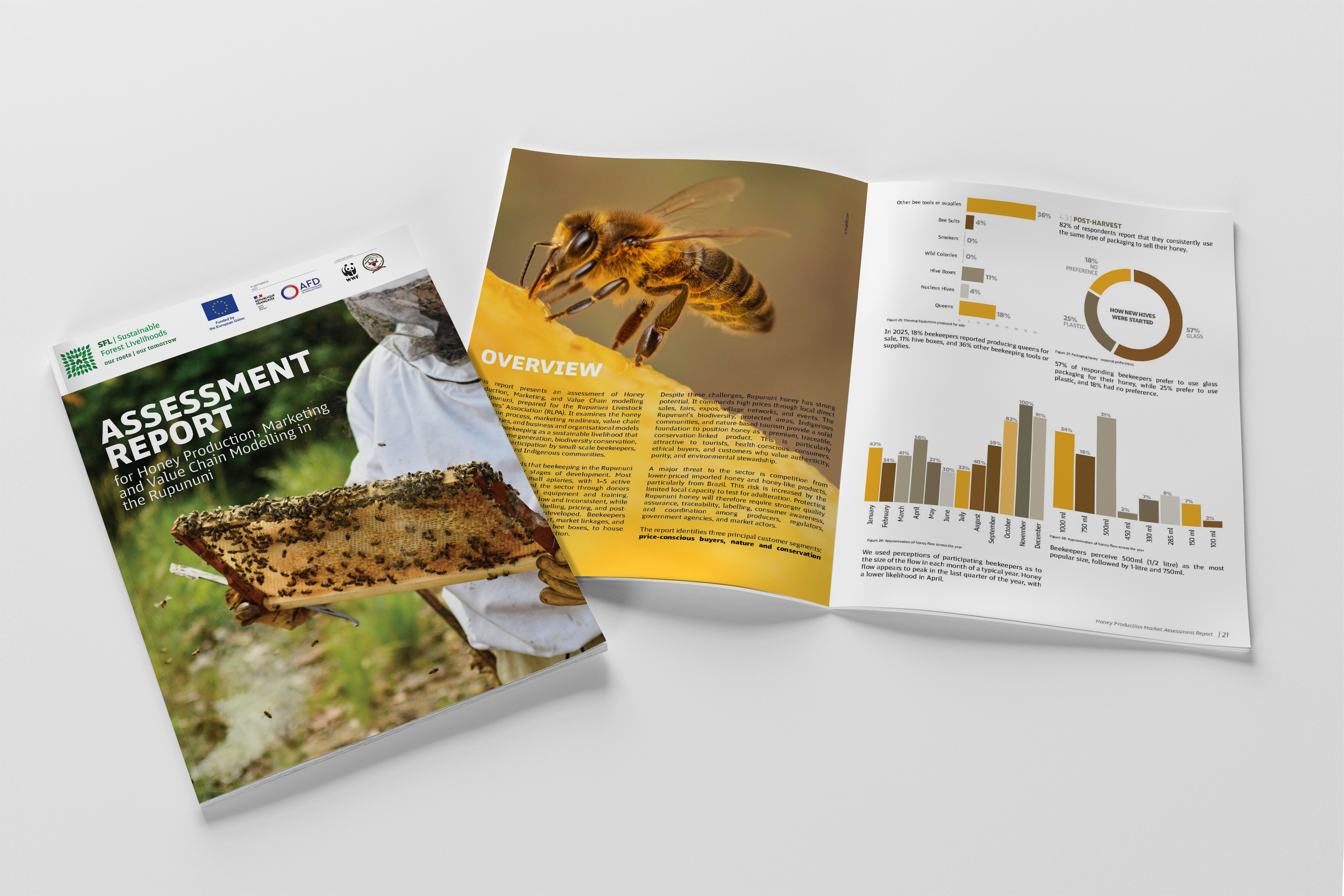
The report maps the honey value chain to establish current production levels and outline models to improve profitability and cooperation among stakeholders. WWF-Guianas, which implements the SFL Programme, presented copies to the Regional Chairwoman of Region 9, Ms Vania Albert, the Agriculture Department, along with other key stakeholders, including the Guyana Livestock Development Authority, Guyana School of Agriculture, and Guyana Marketing Corporation.

In addition to handing over the reports, WWF and the RLPA distributed beekeeping equipment in three of the seven Rupununi communities supported by the SFL Programme. This equipment was distributed under a sub-grant with RLPA; the first tranche included 40 beekeeping boxes, 20 bee colonies, 16 locally sewn bee suits, and other processing equipment, shared among eight beekeepers in Crashwater, Toka, and Masara. The remaining four communities will receive support in the coming months, as RLPA delivers further training in apiary management and other beekeeping practices and works with local stakeholders on safety, quality control, branding and market linkages.

The SFL team also held monitoring sessions with RLPA, the Kanuku Mountains Community Representative Group (KMCRG) and the Bina Hill Institute (BHI) to advance other aspects of the honey production work. This includes developing a beekeeping course for integration into BHI's curriculum and distributing training materials to the communities.
The SFL Programme promotes forest-friendly livelihoods, with a particular focus on honey production in the Rupununi, where established interest and commitment among beekeepers, combined with a healthy surrounding ecosystem, make the activity a viable source of income.

Follow-up initiatives are planned for the remaining communities in the coming months. The SFL team and RLPA will extend equipment distribution to the other four communities, deliver further training in apiary management and honey processing, and continue working with partners on quality control, branding and market linkages so that all seven communities can benefit from a strengthened honey value chain.
